
Share / Shape / Speak
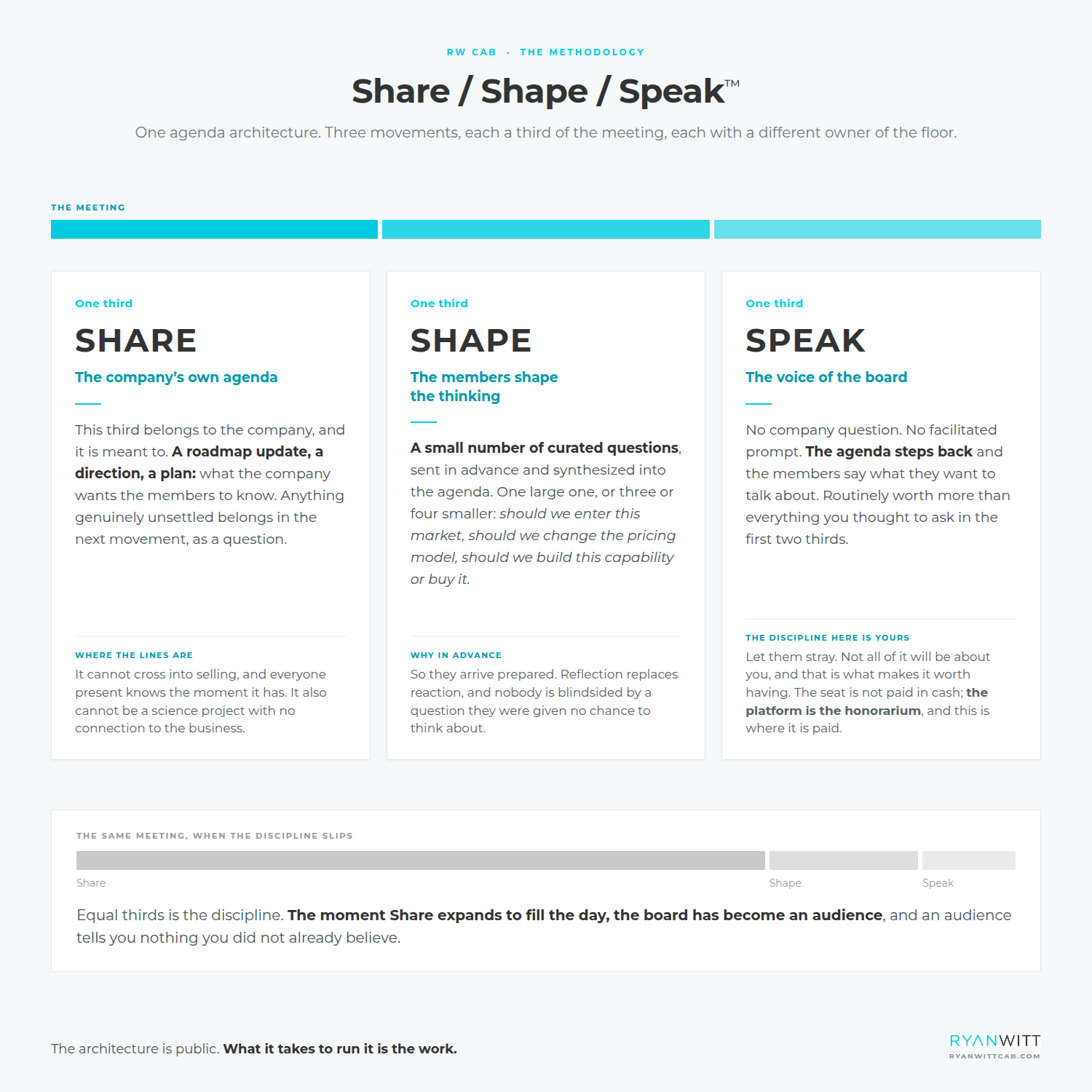
One agenda architecture, three movements, equal thirds. The ratio is the discipline, and it is what separates a board from an audience.
Most advisory board agendas are built the way a conference agenda is built. Someone assembles a list of topics, allocates time to each, and the meeting runs until it stops. That produces a day that is full and a board that does not come back.
The architecture below is the one I have used across four boards and fifteen years. It is not complicated. Its whole difficulty is that each movement has a different owner of the floor, and the company has to give two of them away.
Equal thirds
One meeting, three movements, each roughly a third of it.
The ratio is the whole thing. The moment the first movement expands to fill the day, the board has become an audience, and an audience tells you nothing you did not already believe. In a virtual session the company should hold the floor for no more than a fifth of it, or the meeting becomes a webinar and nobody returns.
Everything else here is detail. If you take one thing, take the thirds.
The simplest way to hold the three in your head: the first is what the company wants the members to know, the second is what it wants to ask them, and the third is whatever they want to raise. Tell, ask, listen, in that order and in equal measure.
Share: the company’s own agenda
This third belongs to the company, and it is meant to.
Everybody in the meeting knows that vendors sell. Pretending otherwise for two days insults the members and leaves the sponsor feeling they have handed over their own board for nothing. So the architecture gives the company a third of the meeting to say what it wants the members to know. A roadmap update, a direction, a plan, where the business is going and why.
It goes first because the questions in the second movement land better once the group knows where the company believes it is heading.
Two boundaries, pulling in opposite directions
It cannot be overt. Nobody from sales presents. It is not the deck being run at tomorrow’s webinar for a thousand registrants. The register is more considered than that, and the members detect the difference within a minute.
And it cannot be a science project. A session with no visible connection to the company’s mission or its growth reads as an academic exercise, and senior people who suspect they are in one stop offering anything worth having. The company is allowed to care about the outcome. It has to.
Between those two is the movement, and the only hard line is selling. That line is not measurable, and pretending otherwise helps nobody, because everyone present knows the moment it has been crossed. Which is exactly why it is worth naming at the charter rather than leaving it as an unspoken norm. A rule everyone recognizes but nobody has said is a rule that gets tested. Stated in advance, the chair can call it in the moment without it becoming a confrontation.
This is also the movement that makes the other two possible. A sponsor being asked to give away two thirds of their own board accepts it far more readily when the first third is genuinely theirs.
Shape: the members shape the thinking
A small number of curated questions, sent to the members in advance and synthesized into the agenda.
It does not have to be one question. It can be a single large one, or three or four smaller ones, and the smaller ones need not be large topics at all. Should we enter this market. Should we contemplate a new pricing model. Should we bring on a new capability organically or by acquisition.
This is also where anything genuinely unsettled belongs. An open strategic question sent in advance gets a considered answer. The same question raised from the stage gets a reaction.
In advance is not a logistical detail
This is the step most easily lost when a meeting is assembled late, and losing it costs more than it looks like it should.
Reflection replaces reaction, so the discussion starts at altitude rather than from a standing start. And nobody is blindsided. A senior executive asked for a considered view on something they first saw ninety seconds ago will give a shallow answer, or resent being put in that position, and usually both.
Preparation time is a form of respect, and members read it as one.
Speak: the members hold the floor
No company question. No facilitated prompt. The agenda steps back and the members say what they want to talk about.
This is the voice of the board, or more usefully the voice of the market, and it is routinely worth more than everything the company thought to ask in the first two thirds.
Let them stray
They will talk about things that are not pertinent to your company or your products. That is not the movement failing. That is the movement working.
What you get is what is actually on their minds, which is by definition not something a company-written agenda could have surfaced.
It is also what they are owed. Board members are not paid a stipend. What they are given is the platform: the convening, the peers, the forum, a conversation they cannot easily get anywhere else. That is the honorarium, and this is the movement where it is paid. A company that reclaims this third for its own agenda has taken the seat and given nothing back for it.
The most senior company person present usually dislikes this movement. It is unstructured, it is not about them, and it goes somewhere they did not choose. They have to sit with it, and that is easier said than done.
When the discipline slips
The same meeting, badly run, is recognizable at a glance. Share swells. Shape compresses to a token. Speak disappears.
What is left is a company presenting to its customers with a question and answer session at the end. Everyone is polite, nothing is learned, and when the invitation goes out the following year a third of the board finds a conflict.
Why the architecture is public
The three movements are not a secret and there is no value in treating them as one. Any competent chair can read this and run the shape of it.
What is difficult is holding the thirds when the sponsor wants more time, asking a question the company would rather not hear the answer to, and doing the unglamorous work between meetings that makes members willing to prepare. The architecture is the easy half.
If you are running a board and the thirds have slipped, that is a short conversation and I am happy to have it. Get in touch.
