
Why a Customer Advisory Board Is the Wrong First Instrument
Some companies cannot fill a board yet. Seating one anyway is worse than waiting — but waiting is not the only option.
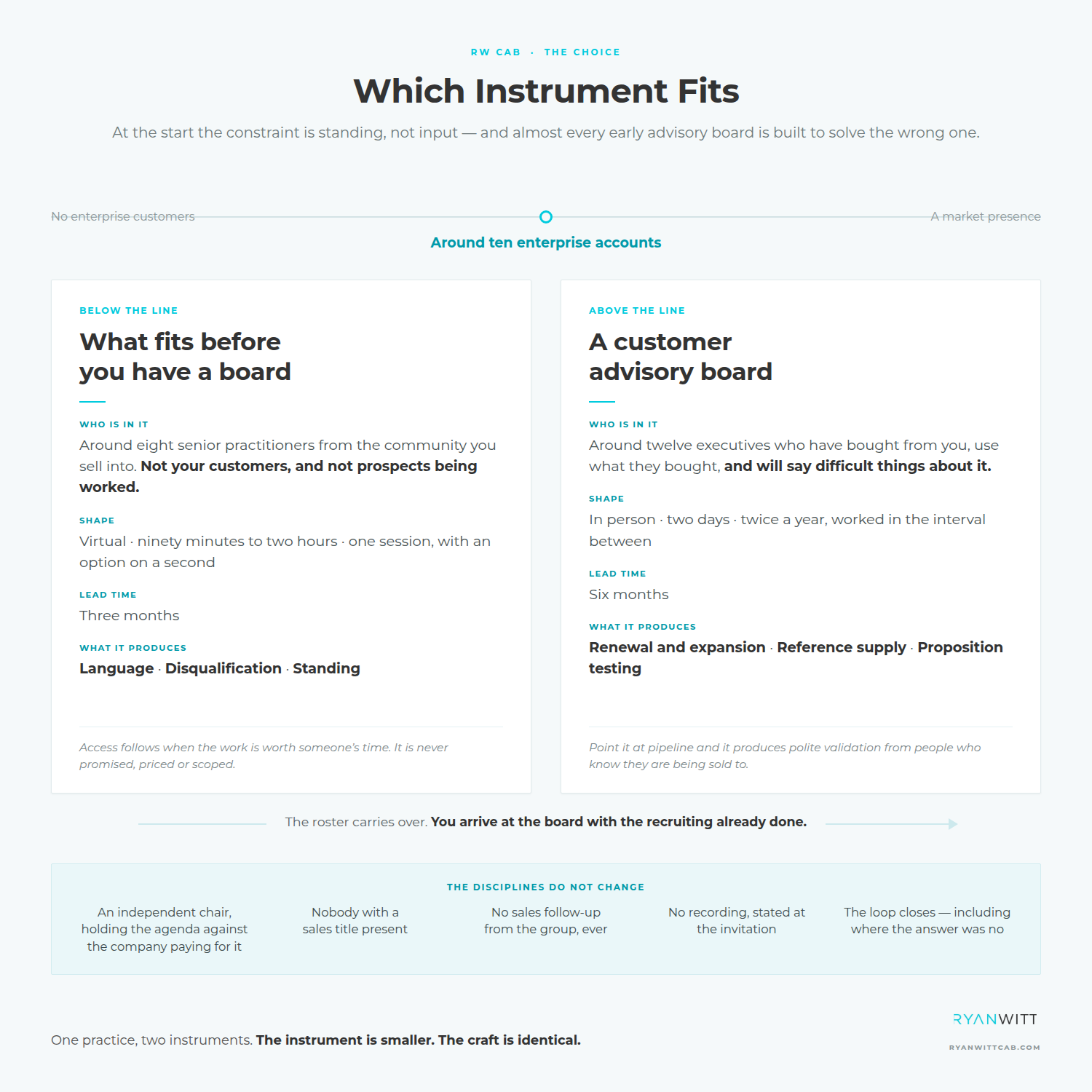
Some companies cannot fill a board yet. Seating one anyway is worse than waiting — but waiting is not the only option.
A customer advisory board is the best instrument I know for finding out what senior buyers actually think. It is also the wrong thing to build first, and a surprising number of companies are sold one before they can hold it up.
The reason is arithmetic before it is anything else.
The arithmetic
A board that works has somewhere around twelve seats. Fill them properly and you need twelve senior executives who have bought from you, use what they bought, and will give up two days a year to say difficult things about it.
A company with six enterprise accounts does not have twelve such people. It has, at best, six — and not all six are senior enough, happy enough, or free enough. So the seats get filled with whoever will come. A friendly champion two levels below the buyer. An investor’s contact who has never used the product. Someone from a target account who has not bought anything and is attending to be polite.
That is no longer a customer advisory board. It is a group of people with different reasons for being there, and it will behave accordingly.
What actually goes wrong, and it goes wrong fast
Two of the six failure modes arrive almost immediately in a board seated too early.
The Sales Agenda arrives first, because it has to. When a third of the board are prospects rather than customers, the company cannot help treating the session as a pipeline event — and the prospects, who are not fools, feel the shift within the first hour. Nothing candid is said after that.
The Fade follows within a year. A thin roster cannot absorb a single departure. One member changes jobs, another misses a session, and a twelve-seat board is suddenly a seven-person call that neither side wants to schedule. The company concludes that advisory boards do not work. What did not work was seating one three years early.
The cost is not the wasted year. It is that you have now spent the goodwill of the few senior people who would have said yes later, and they will remember the meeting that was not worth their afternoon.
The constraint is not what most founders think it is
Ask an early-stage company what it is short of and you will hear customer feedback. That is almost never true. An early company usually has more customer opinion than it can act on — support tickets, sales calls, design partners, the founder’s inbox.
What it is short of is standing.
Its claims are unproven in the buyer’s world. Its founders have no relationships in the buying community. Every first meeting starts from zero trust, and no volume of feedback from the customers you already have repairs that, because the people whose judgment carries weight are not yet in the conversation at all.
Standing is the constraint. Input is not. Almost every early-stage advisory board is built to solve the wrong one.
What fits instead
The instrument that fits before you have a board is smaller, and its central difference is that it does not require customers you do not yet have.
Eight or so senior practitioners from the community you sell into. People with standing in the field, convened to think about a problem they have, with a company that is trying to solve it. Virtual, ninety minutes to two hours, one session with an option on a second — and, critically, a three-month lead time, because senior calendars do not clear inside a quarter and a group assembled in three weeks looks exactly as rushed as it was.
It produces four things, and they arrive in this order.
Language. The words practitioners actually use for the problem, which are almost never the words the company uses. Early positioning fails here first and fails silently — the deck reads well internally and lands on nothing outside. This is the cheapest correction available and it is usually the largest.
Disqualification. Which segments and use cases hold up under questioning by people who do the job, and which are founder theory. Finding out now costs a session. Finding out later costs a year and a hiring plan.
Standing. Third-party judgment that carries weight because it was given in a setting where nobody was selling. A practitioner who has spent two hours thinking seriously about your problem is a different kind of reference from a customer who is merely happy with you.
Access. Practitioners introduce companies they come to believe in, to peers, when they choose to. This one is real and it is the reason people ask about it — so it should be said plainly: it cannot be promised, priced or scoped, and any version of this that sells you a network is selling you something it should not. Access is a consequence of the work being worth someone’s time. It is not a deliverable.
The disciplines do not change
This is where most attempts fail, because the smaller format tempts people to relax the mechanics. The mechanics are the product.
An independent chair, holding the agenda against the company paying for it. Nobody with a sales title present — not the account lead, not the region head, not “just listening,” because the guard goes up the moment a practitioner sees a sales title on an attendee list. No sales follow-up from the group, ever, and one breach ends it. The company goes first and puts something real on the table — ideally something still unsettled, though a direction shared honestly does the job. What it cannot do is cross into selling, and everyone present knows the moment that line is crossed. No recording, stated at the invitation rather than at the session. And the loop closes: what was heard is written up, and what changed because of it is reported back, including where the answer was no.
Those are the same disciplines that hold off the same failure modes in a full board. The instrument is smaller. The craft is identical.
What it turns into
This is the part worth saying out loud at the beginning, because it answers the obvious objection — why not just wait until we have customers.
The practitioners who spent a year being useful to a company they believed in are, disproportionately, the people who go on to buy from it. And when there are finally enough customers to seat a real board, the recruiting is largely done. The relationships exist, the format is understood, and the company has already learned how to sit in a session where it is not in control of the conversation.
Waiting gets you a board eventually. Doing this gets you the same board, earlier, with a year of standing already banked.
Who this is not for
It is worth being blunt about the disqualifiers, because they are the same ones that make it work.
It is not for a company that wants leads. It is not for a company that wants an introduction list. And it is not for a company whose CEO will not attend — at this stage the practitioners are forming a judgment about the founder at least as much as the product, and a session the CEO delegates is not worth convening.
If those three are acceptable, the test is simple. Fewer than about ten enterprise accounts, a vertical you have picked or will pick shortly, and a list of real names you have actually spoken to.
The honest summary
If you have the customers, build the board. It is the better instrument and nothing here replaces it.
If you do not, the choice is not board or nothing. It is a smaller, quieter thing that solves the constraint you actually have — and leaves you holding the roster for the board you will build in two years.
If you are trying to work out which one you are, that is a short conversation and I am happy to have it. Get in touch.
The Six Ways Customer Advisory Boards Fail
Most customer advisory boards do not collapse. They quietly stop being worth anyone's time, and nobody says so.
Most customer advisory boards do not collapse. They quietly stop being worth anyone’s time, and nobody says so.
Every senior executive has been asked to join one. Most have concluded that the value is nominal, and they are usually right. That is not because the idea is weak. It is because six specific things go wrong, they go wrong predictably, and almost nobody designs against them.
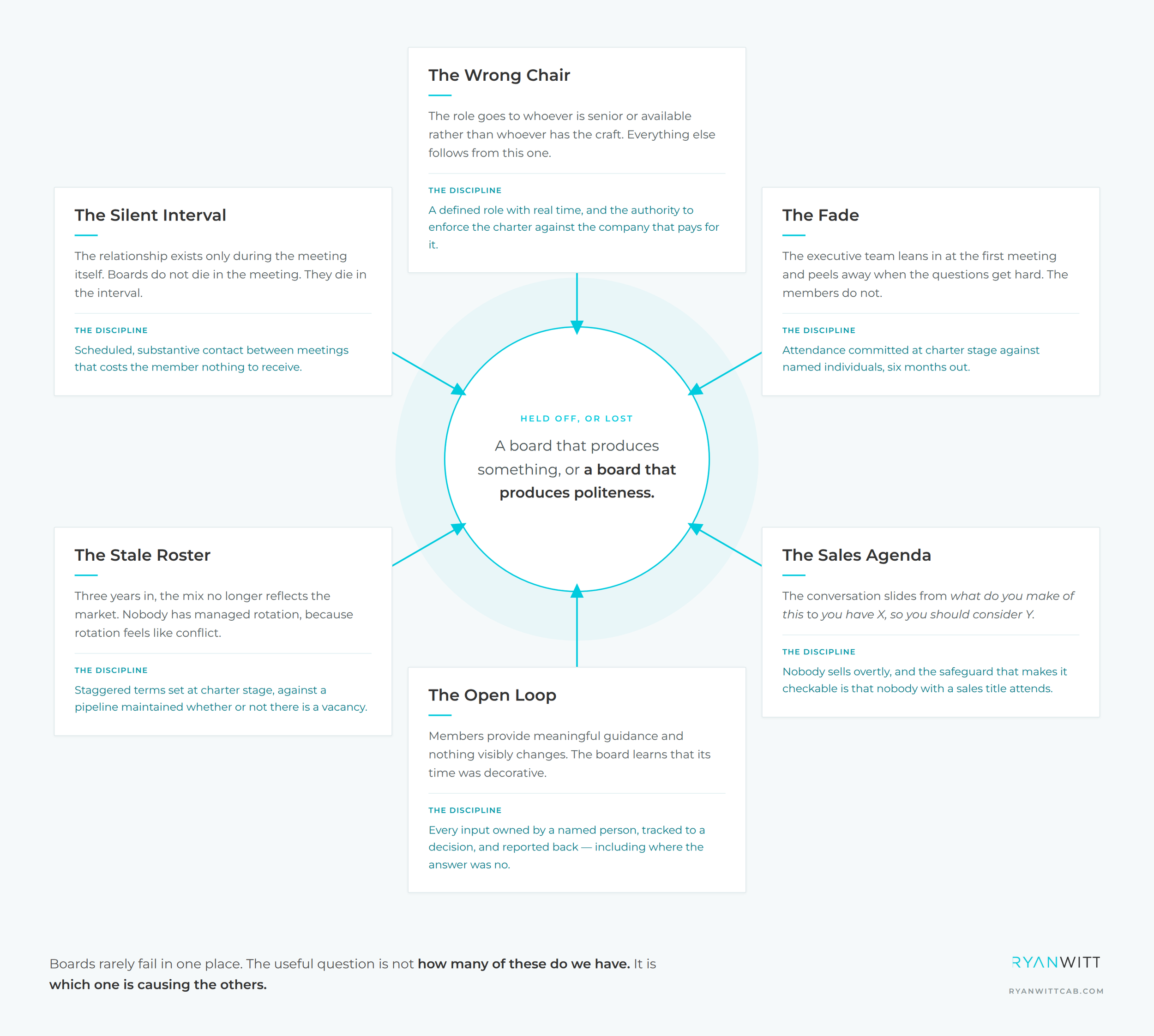
These are not process defects. They are continuous pressures. A chair does not eliminate them once and move on. A chair holds them off, permanently, and the difference between a board that produces something and a board that produces politeness is whether anyone is doing that work.
What follows is the diagnostic. Six modes, and the discipline that holds each one off.
1. The Wrong Chair
The pathology. The role goes to whoever is senior or available rather than whoever has the craft, and it becomes a part-time duty for someone with no time to spare. Everything else on this list follows from getting this wrong.
The discipline. The chair is a role with a job description, not a duty added to one. Named accountability for the board’s outcome, resourced with real time, and holding the authority to enforce the charter against the company that pays for it. Independence is not a nicety here, it is the mechanism. A chair who reports to the person whose agenda they must sometimes refuse cannot do the job.
2. The Fade
The pathology. The executive team leans in at the first meeting and peels away once the easy energy gives way to hard questions. The members do not. When commitment stops being mutual, the best members leave first, and they leave quietly.
The discipline. Executive commitment is contracted in advance and worked in the interval. Attendance is a commitment made at charter stage against named individuals, not a diary decision taken six weeks out. The pre-meeting one-to-ones are the mechanism rather than a courtesy: an executive who has spoken to three members individually before the meeting arrives invested rather than scheduled.
In advance has a number, and it is six months. A senior calendar cannot absorb a multi-day commitment at short notice, and neither can a venue. A board scheduled eight weeks out has already decided who will not attend.
3. The Sales Agenda
The pathology. Roadmap belongs in the discussion. The board pressure-testing draft thinking is the entire point. It fails on the slide from what do you make of this to you have X, so you should consider Y.
The discipline. Nobody sells overtly, and the rule is a tactic rather than a moral position.
Everyone in the discussion is selling all the time and everyone knows it. The CEO, the CMO and the chief product officer are measured on growth. It would be naive to pretend otherwise. What separates a board that works is the discipline to architect the conversation so that it does not feel like one. Overtness is the failure, not commercial intent, and the moment it turns overt senior people tune out fast.
The safeguard that makes it enforceable is simple and checkable: nobody with a sales title attends. Not the account team, not the region lead, not sales leadership. The guard goes up the moment a member sees a sales title on the attendee list, and the people carrying those titles often cannot resist turning the conversation transactional. That is not a character flaw. It is what they are paid for.
“He wouldn’t let us sell in it, and that was the biggest reason it worked.”
Todd Fritsche, Regional Director – Healthcare, Zscaler
4. The Open Loop
The pathology. Members provide meaningful guidance and nothing visibly changes. No follow-up, no evidence it reached a decision, no sign anyone acted. The board learns that its time was decorative.
The discipline. Every input captured against a named internal owner, tracked to a decision, and reported back to the board with the outcome, including where the answer was no and why.
The negative report is the load-bearing part. Members can accept a decision that went against them. They cannot accept silence, and silence is what teaches them their time was theater.
5. The Stale Roster
The pathology. Three years in, half the roster has moved on and the mix no longer reflects the market. Nobody has managed rotation, because rotation feels like conflict.
The discipline. Partial, continuous rotation against a standing pipeline. Terms are defined and staggered at charter stage, so a departure is a scheduled event rather than a conversation somebody has to have. A recruitment pipeline is maintained whether or not there is a vacancy, which is what stops replacement from becoming a crisis.
Rosters do not go stale all at once. They go stale in parts, gradually. A long-tenured member is not evidence of staleness. He is evidence that rotation was managed around him, and five years in the same seat is a success when the seats either side of it turned over on schedule.
6. The Silent Interval
The pathology. The relationship exists only during the meeting itself. Boards do not die in the meeting. They die in the interval.
The discipline. Scheduled, substantive contact between meetings that is not a sales touch and does not require the member to do anything. The test is whether a member hears from the board in a way that costs them nothing: a finding, an introduction, a question worth their view.
This is related to the Fade without being identical to it. The Fade is executive commitment decaying. The Silent Interval is the member relationship decaying. The same problem seen from two ends.
The diagnosis is almost always plural
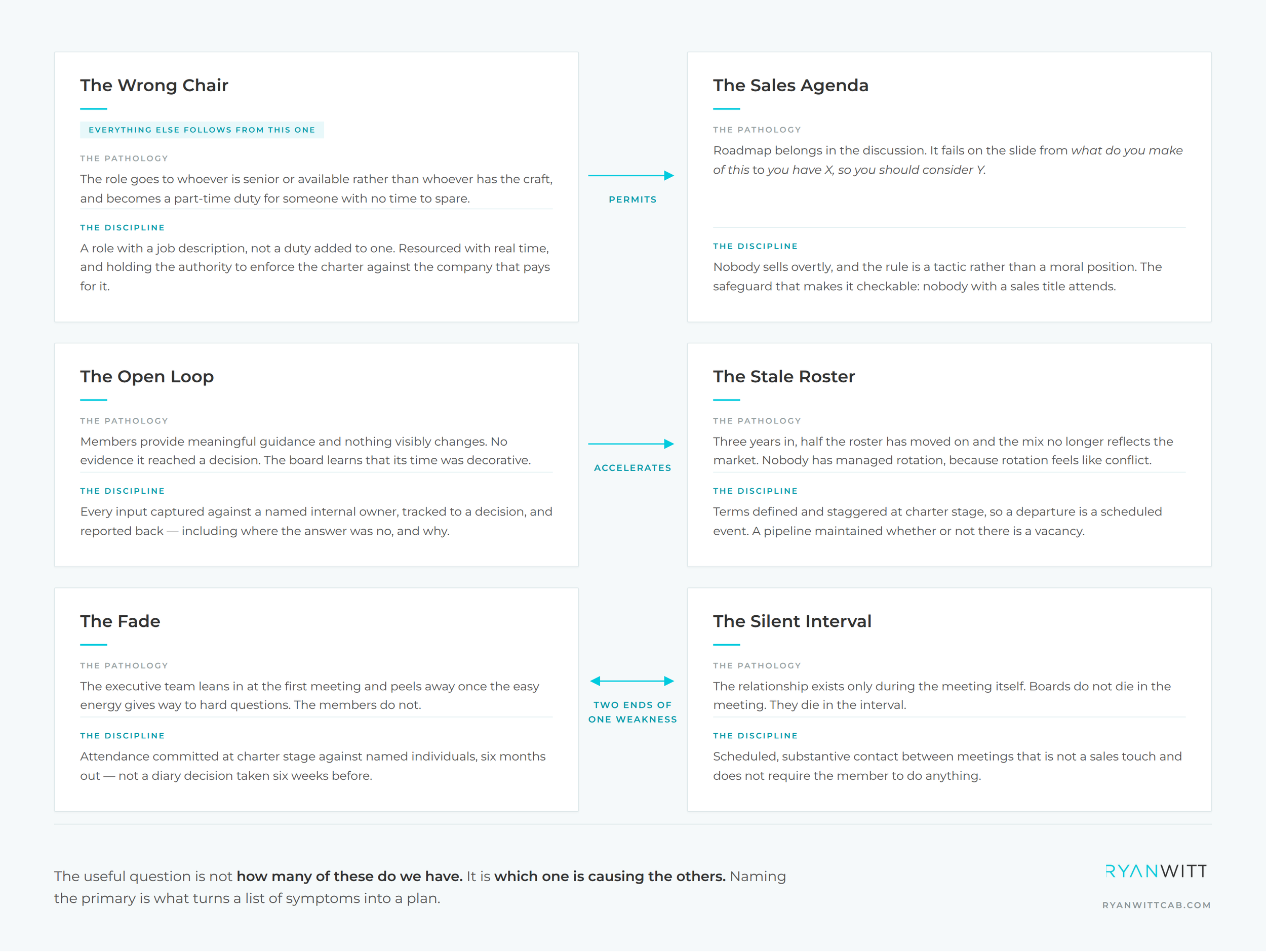
Boards rarely fail in one place. They fail in several, and the modes drive one another. A Wrong Chair permits a Sales Agenda. An Open Loop accelerates a Stale Roster. A Fade and a Silent Interval are usually the same weakness observed from opposite sides.
Which is why the useful question is not how many of these do we have. It is which one is causing the others. Naming the primary is what turns a list of symptoms into a plan.
Where this came from
Fifteen years chairing CxO customer advisory boards, most recently at Proofpoint. The six modes are what recurred, across companies and across sectors, and the disciplines are what held them off.
You can use this as it stands. Read the six, decide honestly which are present, and start with the one driving the rest.
What this cannot tell you is where your own board actually sits. That requires talking to your members, and members will not give a straight answer to the company that convened them. It is the one part of this that cannot be done from the inside.
If that is the question, the CAB Assessment is four weeks and answers it.